

New Markers Celebrate Stories of Courage, Freedom, and History Across the Tri-State Region
New Markers Celebrate Stories of Courage,
Freedom, and History Across the Tri-State Region
Sasha Bush
The Ashland Beacon

By preserving the past, the Appalachian Freedom Heritage Tourism Initiative is inviting visitors to walk the paths of those who fought for freedom.
History came alive across the Tri-State Region yesterday as community leaders, historians, and residents gathered in Boyd County, Kentucky, to dedicate two new historical markers honoring the courage, determination, and resilience of freedom seekers who traveled through Appalachia on their journeys toward freedom.
The dedication of the Asbury Parker Memorial and the Piketon 59 Escape Site marked another milestone in the Appalachian Freedom Heritage Tourism Initiative (AFHTI), a multi-state effort dedicated to preserving and sharing the stories of Underground Railroad sites throughout Ohio, Kentucky, and West Virginia.
For Marty Conley, who is with the Lawrence Economic Development Corporation, Chamber of Commerce, and Tourism Director for Lawrence County, Ohio, the project represents years of dedication and a commitment to ensuring these stories are never forgotten. “I know that's a lot of words, but this is a project that I've been working on for about four years,” Conley said. “It is a project where we recognize and preserve the history of Underground Railroad sites in the tri-state area.”
The initiative brought together partners from Kentucky, West Virginia, and Ohio with a shared goal of identifying and preserving more than 27 historic locations connected to the Underground Railroad.
“We have been a collaborative effort,” Conley explained. “Kentucky, West Virginia, and Ohio. Our goal was more than 27 sites, and we have done that.”
The project has now entered a new phase with the installation of historical markers at each location. Each marker includes a QR code, allowing visitors to use their phones to access additional information about the site and the people whose stories shaped the region’s history.
“So now we're in the phase of marking the sites with a marker at each one,” Conley said. “Each site has a QR code that you can scan with your phone and that will pull up information about the site.”
Conley said preserving these stories is essential because history has the power to educate, inspire, and connect future generations.
“It is really important that we preserve the history, so it doesn't go away,” Conley said. “We need to protect it for future generations.”
The Appalachian Freedom Heritage Tourism Initiative was made possible through the efforts of 18 partner organizations and a $1.5 million grant from the Appalachian Regional Commission.
Honoring the Journey of Asbury Parker
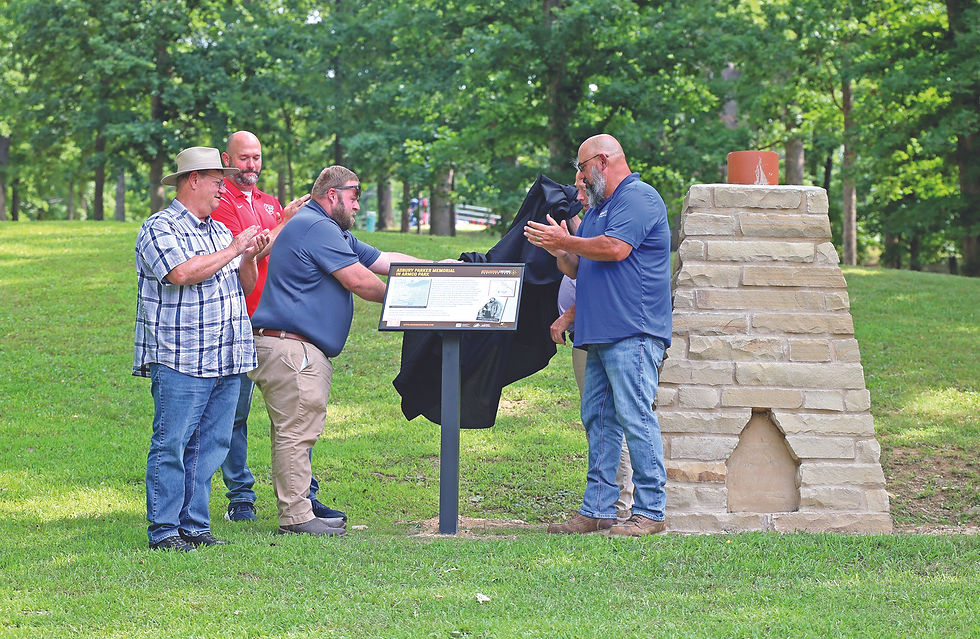
The first dedication ceremony took place at ARMCO Park, where the Asbury Parker Memorial and National Underground Railroad Network to Freedom marker were unveiled.
The memorial honors Asbury Parker, who escaped slavery in 1857 from nearby Clinton Furnace. After crossing the Ohio River near present-day Huntington, Parker received assistance from Underground Railroad networks in Ironton and Lawrence County before continuing his journey north and eventually reaching freedom in Canada.
The monument, located at the entrance to ARMCO Park, was designed as a scale replica of the now-demolished Clinton Furnace stack. It was created through a partnership between Boyd County Parks and Recreation and Shawnee State University’s Center for Public History. Randy Stapleton Masonry donated materials and labor to bring the project to life.
Conley said the memorial provides visitors with the opportunity to follow Parker’s incredible journey through the region.
“The Asbury Parker Memorial is an invitation to explore one of the most remarkable freedom-seeking journeys documented in our region,” Conley said.
“Visitors can begin at ARMCO Park in Boyd County, where Parker's 1857 escape from Clinton Furnace is commemorated, and then follow his route through sites recognized by the National Park Service's Network to Freedom Program and the Appalachian Freedom Heritage Tour, including sites in Huntington, West Virginia, and Burlington, Ironton, and Blackfork in Lawrence County, Ohio.”
Remembering the Piketon 59

The second dedication took place at the Catlettsburg Riverfront, where a marker was unveiled honoring the Piketon 59 Escape Site.
The site commemorates one of the largest documented group escapes of freedom seekers in Kentucky history. In April 1862, during military operations in the Big Sandy Valley led by future President James A. Garfield, 59 enslaved individuals seized an opportunity created by the Union advance and escaped.
Rescued by the steamer Piketon, the group was transported to Catlettsburg before continuing their journey to Portsmouth, Ohio.
Dr. Drew Feight, Director of Research and Outreach for the Appalachian Freedom Heritage Tourism Initiative, said the story represents the courage and determination of people who actively fought for their freedom.
“These two markers remind us that freedom was won through the courage and determination of the people who sought it,” Feight said.
“The Escape of the Piketon 59 demonstrates that enslaved men, women, and children were not passive observers of the Civil War. They actively seized opportunities created by the conflict, helping transform the meaning of the war and hastening the destruction of slavery.”
A New Destination for History Lovers
Andrew Steele, Executive Director for Boyd County Tourism, said the new markers provide an exciting opportunity for visitors to discover the region’s important African American history.
“I'm excited that Boyd County has the opportunity to showcase two sites on the Appalachian Freedom Heritage Tour,” Steele said. “We can't wait for visitors to discover the unique freedom-seeking stories and the impact of African Americans in Appalachia's history.”

The Appalachian Freedom Heritage Tourism Initiative is part of a larger effort to preserve Underground Railroad history throughout the region. The National Underground Railroad Network to Freedom Program, created by Congress in 1998 and administered by the National Park Service, recognizes and preserves locations connected to resistance against enslavement through escape and acts of freedom seeking. The program now includes more than 800 listings across the United States and beyond.
For visitors looking to experience history firsthand, the Appalachian Freedom Heritage Tour offers more than markers and monuments—it offers a chance to stand where freedom seekers once walked, learn the stories behind their journeys, and understand the courage that helped shape America’s history.
To learn more about the Appalachian Freedom Heritage Tourism Initiative and plan a visit, visit www.appalachianfreedom.com.


Comments